There was a time when writing for SEO meant repeating the same phrase until it hurt to read it. “Best running shoes,” “running shoes for men,” “cheap running shoes.” The old-school formula was simple — match what people typed, and Google would reward you.
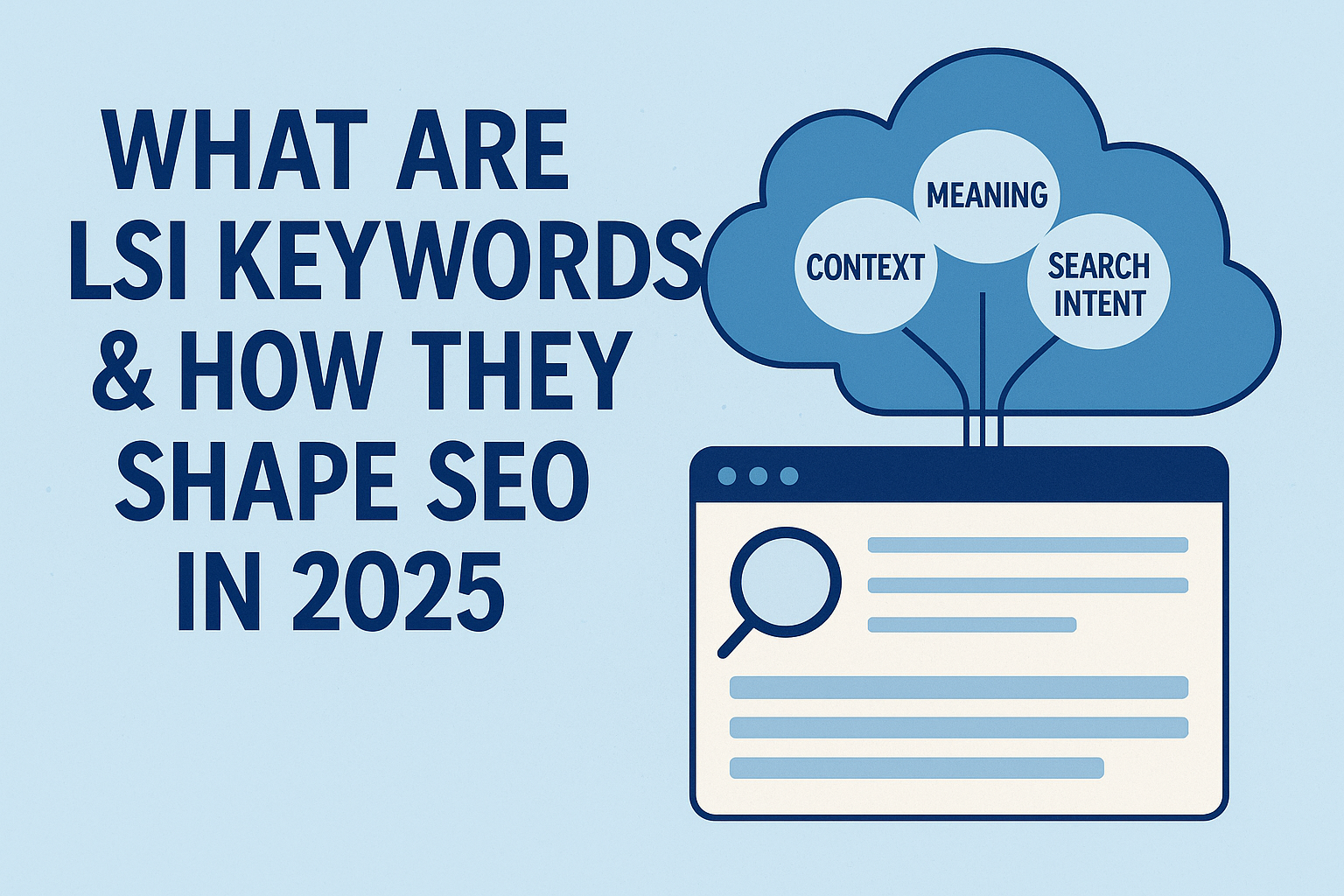
But search engines have grown up. They’ve learned to read, reason, and connect dots like we do. That shift gave rise to one of the most misunderstood concepts in SEO — LSI keywords.
Marketers still toss the term around as if Google has a secret LSI switch inside its algorithm. Spoiler: it doesn’t. But the idea behind LSI — understanding related meaning — has quietly shaped how good content ranks today.
Let’s unpack what LSI keywords really are, why they still matter (even under a different name), and how you can use them to make your content read better, rank faster, and stay completely AdSense-safe.
The Story Behind “LSI” — and Why It Refuses to Die
To understand LSI, we have to travel back to the 1980s — before TikTok, before ChatGPT, before Google even existed. Researchers at Bell Labs created a method called Latent Semantic Indexing, a statistical model that studied how words relate to each other across massive text collections.
The goal wasn’t to optimize blog posts. It was to help computers understand that words like “car” and “automobile” often appear in similar contexts — so they probably mean the same thing.
Fast forward to the SEO era, and the term resurfaced. Content creators began using “LSI keywords” to mean words related to a topic, even if the math behind it wasn’t really in play. Google later clarified it doesn’t use LSI specifically — but its algorithms definitely use semantic relationships.
That’s why the concept still survives. We may have dropped the math, but the meaning remains:
Write naturally, include context, and your content will make sense — to both humans and algorithms.
From Keywords to Meaning: SEO’s Maturity Moment
If 2010’s SEO was about “keywords,” 2025 SEO is about intent and interpretation.
Google’s systems like BERT, RankBrain, and now Generative Search no longer just match words; they match concepts. When you search for “how to speed up a slow WordPress site,” Google understands you might also want “optimize images,” “reduce plugins,” or “improve Core Web Vitals.”
That’s why semantic relevance matters more than ever. You don’t need to stuff “speed up WordPress site” ten times — you just need to talk about what people actually mean when they search it.
In that sense, “LSI keywords” aren’t special magic words — they’re your way of speaking the full language of your topic.
A Simple Example: How Context Changes Everything
Let’s say you’re writing about apple.
If your post also includes words like “orchard,” “fruit,” or “pie,” search engines know you’re talking about the food.
But if you mention “iPhone,” “MacBook,” or “App Store,” it’s clear you mean the company.
That’s semantic understanding — and it’s exactly what Google uses to decide which page deserves to rank.
LSI, in this sense, was the seed that grew into semantic SEO — where meaning, not mere repetition, defines visibility.
Finding the Right Related Keywords (Without Chasing Buzzwords)
Many tools promise to “generate LSI keywords.” Most of them are just finding phrases that appear near your main keyword on top-ranking pages — which is fine, but not magic.
Here’s a more human-driven way to find semantically related terms that actually make sense:
- Start with search intent.
Ask: What does the reader really want to know? If your keyword is “meta description,” the reader probably also cares about “click-through rate” or “SERP preview.” - Use Google’s built-in hints.
Check the “People also ask” box and “Related searches” at the bottom. That’s the web’s most honest keyword research tool — straight from user curiosity. - Observe how competitors explain things.
Don’t copy — just notice what concepts appear repeatedly. If every top page on “backlink audit” also discusses “toxic links” or “anchor text,” those belong in your piece. - Group by theme, not phrase.
Instead of building a mechanical keyword list, create clusters:- Core term: “on-page SEO”
- Supporting terms: “meta title,” “URL structure,” “alt text,” “internal linking”
- Intent modifiers: “how to,” “guide,” “checklist,” “examples”
- Speak like a person, not a thesaurus.
Don’t force “semantic SEO” into every line. Use it where it fits — like seasoning, not the main dish.
A Writer’s Trick: Imagine Explaining It Out Loud
If you were sitting across from a new intern or a curious client, how would you explain your topic?
You’d naturally mention supporting ideas, examples, or comparisons. That’s the same energy your content should carry.
For instance, instead of repeating “SEO keywords” five times, you might say:
“Think of your keywords as the bridge between what people search and what you offer. The trick is choosing words that sound like your customer — not your marketing team.”
That line alone includes “keywords,” “search,” and “offer” — three related signals that Google connects semantically.
When you write for people first, the algorithm follows along.
Best Practices: Blending Keywords, Context, and Flow
Let’s distill this into simple, practical rules you can apply in every post:
1. Lead with clarity, not cleverness.
A headline that says “Master Semantic SEO in 7 Simple Steps” beats one stuffed with five versions of “LSI.”
2. Use 1 primary keyword + 3–5 supporting terms.
That’s enough to signal depth without sounding formulaic.
3. Include them in smart places.
- Title: once.
- Intro: naturally, within 100 words.
- Subheadings: where context fits.
- Image alt text: describe visuals in plain English.
- Internal links: use contextual anchors like “learn advanced topic clustering” instead of “click here.”
4. Keep density organic.
If you’re counting keywords manually, you’re already doing it wrong. Focus on readability; that’s the new metric.
5. Use examples, stories, or analogies.
Readers remember “real” explanations better than jargon.
For example:
“Semantic SEO is like cooking — the ingredients matter, but flavor comes from how you combine them.”
Common Mistakes That Still Haunt SEO Writers
Even seasoned content creators fall into these traps:
- Stuffing related terms unnaturally.
Example: “These LSI keywords help your LSI keyword strategy with LSI tools.” That’s not SEO — that’s a red flag. - Using irrelevant ‘related’ phrases.
Just because “content marketing” appears near “SEO” online doesn’t mean it belongs in every SEO post. Stay on theme. - Ignoring intent mismatches.
Don’t write a tutorial when readers expect a definition — or vice versa. Google notices when users bounce back quickly. - Overusing AI tools without editing.
Generative text often lacks rhythm and variety. Always read your post out loud — if it sounds too smooth, it’s probably too artificial.
Beyond LSI: How Modern Algorithms Actually See Your Content
Today’s search engines don’t just count keywords — they understand them.
With transformer models like BERT and MUM, Google builds a multidimensional “map” of meaning. It sees how words relate to entities, tone, and context.
In practical terms:
If your article about “keyword research” also discusses “user intent,” “search volume,” and “competition,” it forms a complete picture. The algorithm knows it’s not thin content.
The good news? You don’t need to think like a machine to please one. You just need to write like someone who knows their subject — and explains it clearly.
A Real-World Use Case
Imagine you’re optimizing a page about image SEO on your site.
Instead of hammering “image SEO” repeatedly, you’d naturally mention:
- File compression
- Alt attributes
- Lazy loading
- Page speed
- Accessibility
Each of those is semantically linked. You’ve built a contextual network of meaning — the kind of language search engines understand best.
That’s how “LSI keywords” quietly power visibility, without ever being the star of the show.
How to Test If You’re Using Enough Context
Here’s a quick checklist:
- Does your article answer all major questions around the topic?
- Do the subheadings naturally expand the main idea?
- Would a reader feel “done” after reading, or would they need to search again?
- Do the related terms appear naturally, not forced?
If you can answer yes to most, you’re already nailing semantic optimization — no special plugin required.
The Connection to GEO — Generative Engine Optimization
Search in 2025 is no longer just ten blue links. AI overviews, conversational snippets, and “answer boxes” dominate visibility.
This is where GEO (Generative Engine Optimization) steps in.
When AI systems summarize content, they pick the clearest, most contextually rich passages.
That means writing structured, answer-friendly sections — concise paragraphs, direct definitions, and naturally phrased subheadings.
Your “LSI” or semantic keywords help these systems recognize that your page covers the full context, making it more likely to be quoted in AI summaries.
It’s the same game — just a new playing field.
A Quick Experiment You Can Try
Pick one of your existing blog posts.
Paste it into a tool like Google’s Natural Language API demo or SurferSEO’s Content Editor.
You’ll see a “topic” graph of terms Google associates with your page.
If your article on “local SEO” doesn’t include “Google Business Profile,” “reviews,” or “NAP consistency,” you’re leaving relevance (and traffic) on the table.
Update it, reindex, and watch how impressions grow for new related queries.
That’s the quiet magic of semantic optimization done right.
Linking It All Together
For SEOphrases.com, this concept ties perfectly across your ecosystem:
- From here, link to SEOTactic.com for advanced topic clustering and data-driven methods.
- Link to SEOShorts.com for two-minute explainers on SEO terms.
- And link to HowToLearnSEO.com for readers who want a full learning roadmap.
You’re building what search engines call a semantic network of expertise — exactly what E-E-A-T (Experience, Expertise, Authoritativeness, Trustworthiness) thrives on.
The Human Side of SEO Writing
The irony is that the more advanced algorithms become, the more they reward writing that sounds human.
Break your rhythm sometimes. Use short sentences. Ask questions. Tell micro-stories.
Algorithms don’t fall in love with you — readers do. And Google follows where people stay.
When you write from real understanding, your content naturally picks up the right terms, tone, and trust signals. That’s the real “latent” meaning hiding behind LSI.
Key Takeaways
- LSI keywords aren’t a tool — they’re a habit. Use related terms to build meaning, not to chase trends.
- Semantic context beats density. If your content sounds natural, it’s already optimized.
- Search engines read like humans now. Give them clarity, flow, and depth.
- Your best SEO strategy in 2025: Be the answer, not the echo.
FAQs (For AEO Optimization)
1. Are LSI keywords still used by Google?
Not directly. Google doesn’t use the old LSI model, but it absolutely uses semantic relationships to understand meaning.
2. What’s the difference between LSI and semantic keywords?
LSI is a theoretical model; semantic keywords are the real-world practice of using related words that support the topic’s meaning.
3. How many related terms should I include?
Enough to sound natural. Aim for 1–3 per paragraph if it fits contextually — not mechanically.
4. Do AI detection tools affect AdSense approval?
Indirectly, yes. If content feels robotic or templated, Google reviewers may flag it as low quality. A human editing pass solves this.
5. How do LSI concepts connect to AI search (GEO)?
Generative engines pick snippets that explain topics clearly. Writing with context and clarity increases your odds of being featured in those answers.