Most marketers chase keywords. The great ones chase intent.
Search engines no longer reward pages that simply match a phrase — they reward those that satisfy curiosity, solve problems, and deliver what users truly meant when they typed that query.
Understanding search intent isn’t a “nice-to-have” anymore. It’s the quiet foundation of every modern SEO content strategy. Let’s unpack what intent really means, how to read it, and how aligning your content with it transforms your rankings, conversions, and user trust.
What Search Intent Really Is
At its simplest, search intent is the reason behind a search.
When someone types “best running shoes,” they’re probably comparing options. But when they type “buy Nike Pegasus 40 online,” they’ve made up their mind.
Both searches involve the same product — yet each represents a completely different mindset.
Search intent bridges the gap between what people search for and why they search for it.
And when your content matches that intent perfectly, Google recognizes you as the right answer — not just another result.
The Four Main Types of Search Intent
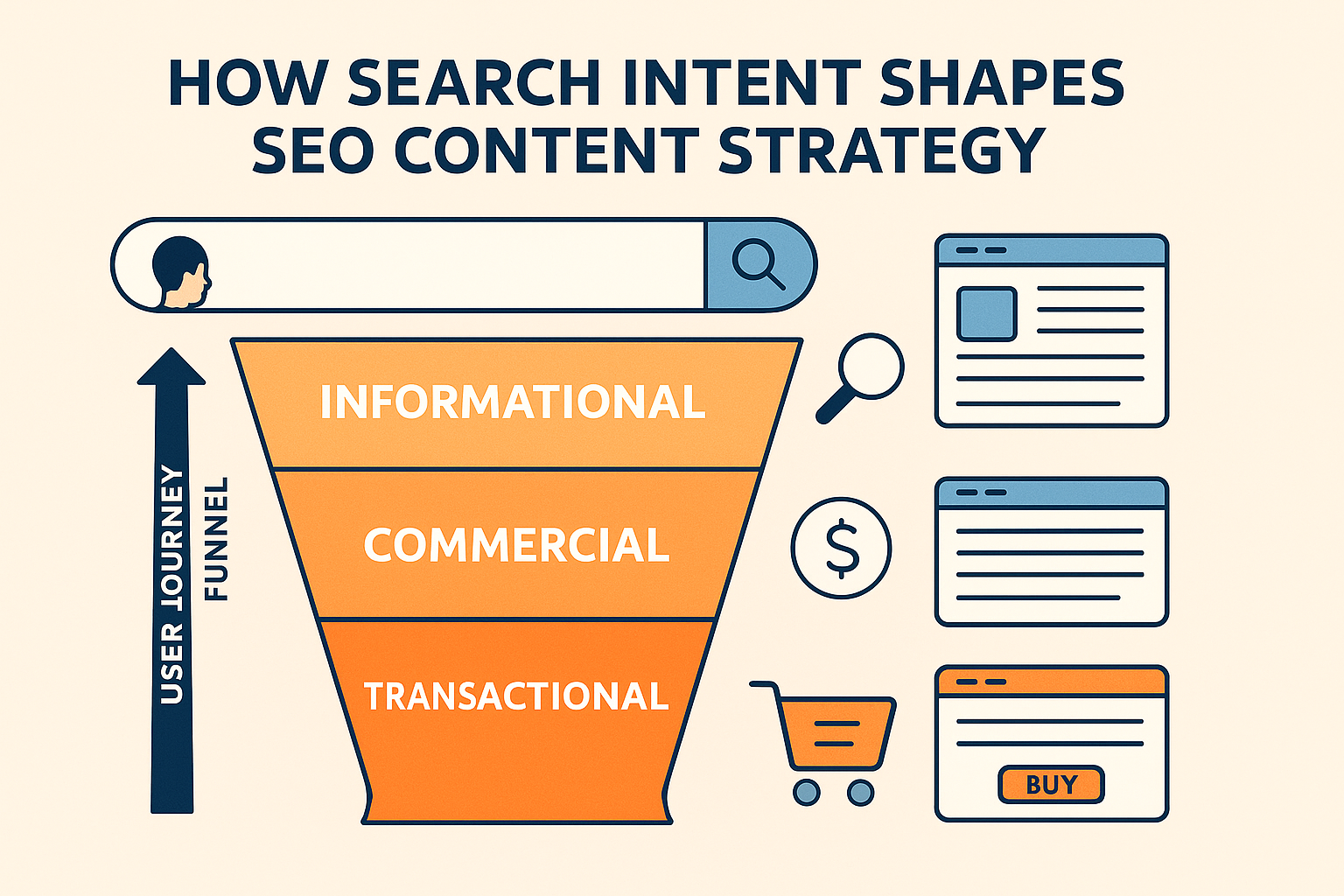
There are endless variations of user behavior, but almost every query fits one of these four core intents:
1️⃣ Informational
People want to learn.
They’re asking questions or exploring a topic.
Examples:
- “What is technical SEO?”
- “How does AI affect search rankings?”
These users aren’t buying yet — they’re building understanding. Your job? Teach them, not sell to them.
2️⃣ Navigational
Users want to go somewhere specific.
They already have a brand or destination in mind.
Examples:
- “Ahrefs blog”
- “Transact Campus login”
For this intent, ranking matters less than usability — make sure branded pages are easily accessible.
3️⃣ Transactional
The searcher wants to do something — usually buy, subscribe, or sign up.
Examples:
- “Buy Rank Math Pro”
- “Download SEO checklist PDF”
These are high-intent, high-CPC terms. Content here should remove friction and reinforce trust.
4️⃣ Commercial / Investigative
This is the bridge stage — the shopper who’s almost ready but still comparing.
Examples:
- “Best SEO tools for small business”
- “Surfer SEO vs Frase comparison”
Here, your content should guide, not pressure — reviews, comparisons, or “best of” lists work beautifully.
Why Intent Matters More Than Keywords
Old-school SEO treated keywords like magic spells. Repeat them enough, and rankings would appear.
Today, Google’s algorithms (think BERT, RankBrain, MUM) understand context and relationships. They’re trained to interpret what the searcher means, not just what they say.
That means:
- Content built purely around keywords often misses the mark.
- Content built around intent earns better engagement, higher dwell time, and more consistent rankings.
When intent and content align, your page naturally collects the right signals — clicks, time on page, backlinks — all without forcing SEO tactics.
How Search Intent Shapes Your SEO Content Strategy
Let’s break down how intent drives decisions at every step of your content workflow.
1. Topic Selection — Write for Curiosity, Not Just Volume
Instead of asking “What keyword has the most traffic?”, ask “What question are people trying to answer?”
For example, “SEO strategy” has huge volume, but “how to build an SEO content plan step by step” converts readers into subscribers.
Intent filters vanity topics from valuable ones.
2. Content Format — Match the User’s Expectation
Every intent type demands a different format:
| Intent | Best Format | Example |
|---|---|---|
| Informational | Guides, how-tos, explainers | “How to Use Rank Math for SEO” |
| Navigational | Landing pages, product pages | “Login / Dashboard” |
| Commercial | Reviews, comparisons | “Ahrefs vs Semrush – Which Wins?” |
| Transactional | Product pages, CTAs | “Buy SEO Tools Online” |
If someone’s looking to compare tools, show a comparison. If they want a tutorial, show steps — not a sales pitch.
3. Keyword Choice — Layer Intent Modifiers
Modifiers (the extra words around a core keyword) reveal intent.
- “Best,” “Top,” “Review” → Commercial
- “How,” “What,” “Guide” → Informational
- “Buy,” “Price,” “Near me” → Transactional
Building your keyword list around these modifiers ensures every piece of content has a purpose — not just a target word.
4. On-Page SEO — Align Language With Motivation
Small language cues shift how readers perceive value.
Example:
Instead of saying “Our tool helps improve SEO,” say “You’ll see exactly which keywords bring you traffic.”
That subtle change moves from a brand-centric tone to a user-centric one — precisely what intent-driven content is about.
5. Internal Linking — Build an Intent Journey
Each piece of content should lead visitors deeper into the funnel:
- Informational → Commercial (learn → compare)
- Commercial → Transactional (compare → buy)
Example flow for SEOphrases.com:
- “What Is Search Intent” → links to “How to Build a Keyword Map” → links to SEOTactic.com’s “Best SEO Tools for Mapping.”
When you structure links by intent, you guide readers and signal relevance to Google.
How to Identify Search Intent (Practical Method)
Let’s say your keyword is “email marketing tools.”
1️⃣ Google It — The SERP tells the story.
If the top results are lists and comparisons, the intent is commercial. If you see definitions or tutorials, it’s informational.
2️⃣ Check Snippets — Featured snippets, “People also ask,” and “Related searches” expose related questions — gold for subtopics.
3️⃣ Study Top URLs — Are they blog posts or product pages? Their structure mirrors the audience’s mindset.
4️⃣ Use Tools Wisely — Semrush, Ahrefs, or Rank Math’s Content AI highlight intent-related keywords automatically.
Example: One Keyword, Four Intents
Let’s look at “keyword research.”
Depending on context, it can represent four different intents:
| Search | Implied Intent | Ideal Content |
|---|---|---|
| “What is keyword research” | Informational | Definition + basics guide |
| “Keyword research tools” | Commercial | Comparison / listicle |
| “Buy keyword research software” | Transactional | Product page + CTA |
| “Ahrefs keyword research” | Navigational | Brand landing page |
The phrase stays the same — only intent changes.
Smart SEO content strategy means mapping each keyword to the right intent before writing a single word.
Common Mistakes Marketers Make
Even pros misread intent. Watch out for these traps:
- Publishing one mega-post for everything.
It confuses both readers and Google. - Targeting transactional intent with blog content.
A “Buy Now” CTA on an informational post feels pushy. - Ignoring how SERPs evolve.
Intent can shift — yesterday’s informational query may now trigger AI-generated summaries or shopping results. - Copying competitor content blindly.
Their audience may search differently. Always test your assumptions with live SERPs.
How AI and Generative Search Change the Game
AI-driven overviews and answer boxes have changed how intent is satisfied.
Users often see summaries before clicking — meaning your content must serve both human and machine comprehension.
That’s where GEO (Generative Engine Optimization) comes in. By clearly structuring sections, headings, and concise definitions, your page becomes easier for AI systems to quote.
If your piece directly answers intent-based queries (“What,” “How,” “Why”), it’s more likely to appear in conversational or AI snippets.
So yes, intent still rules — only now it’s being read by both people and algorithms trained to think like them.
How to Build an Intent-Driven Content Plan
Here’s a repeatable framework used by SEO strategists:
Step 1: List Core Topics
Start with 5–10 high-value themes (e.g., On-Page SEO, Keyword Research, Content Strategy).
Step 2: Define Intent for Each Topic
Ask, “What does my audience want to know, compare, or do under this topic?”
Step 3: Assign Content Formats
Map informational to guides, commercial to comparisons, transactional to CTAs.
Step 4: Build Pillar + Cluster Structure
One long pillar (“The Ultimate Guide to Search Intent”) supported by smaller posts (“Informational vs Transactional Intent,” “How to Analyze SERPs for Intent”).
Step 5: Optimize and Interlink
Use Rank Math to connect clusters and assign canonical focus pages.
Step 6: Refresh Regularly
Intent evolves. Revisit SERPs quarterly to keep your pages aligned.
Real-World Example
A content marketing agency noticed their blog traffic was flat. They’d been posting “SEO Tips” and “Keyword Trends” articles — great info, but none targeted specific intent.
They audited 60 posts, re-grouped them by intent, rewrote some as tutorials, merged overlapping guides, and added clear calls to action.
Three months later:
- Organic traffic up 42 %
- CTR up 28 %
- Time on page doubled
It wasn’t more content — it was smarter content.
Key Takeaways
- Intent > Keyword. Always write for the “why.”
- Match format to mindset. Tutorials teach; comparisons convert.
- Read the SERP before writing. It’s your best intent detector.
- Structure content for humans and AI. Clear headings help both.
- Evolve with behavior. Search intent shifts as trends do.
SEO success comes when your content feels like the perfect answer — because it was written with the question in mind.
FAQ
1. What is search intent in SEO?
It’s the purpose behind a query — what the user wants to accomplish when they search.
2. How do I find intent for my keywords?
Analyze top results and snippet types. Lists = commercial, guides = informational, store pages = transactional.
3. Can one page target multiple intents?
Sometimes, but it’s tricky. Split sections clearly or create separate pages if intent differs.
4. Why does intent affect content ranking?
Because Google’s algorithm measures satisfaction — if users get what they expected, your page performs better.
5. How often should I review intent?
Quarterly. SERPs shift with user behavior and new AI features.